Twenty minutes after you leave the Gateway of India, the noise of Mumbai falls away behind you. Then the harbour opens out, the naval docks slide past, and a low green island rises from the Arabian Sea. This is Gharapuri, the City of Caves. Reaching Elephanta Caves by private speedboat turns a half-day of queuing and waiting into a crossing that takes less time than a drive across South Mumbai.
This guide covers everything you need: the history carved into the basalt, the practical detail of timings and tickets, the climb itself, and finally how the private speedboat crossing works for city guests and cruise passengers alike. If you already know you want the fast crossing, you can reserve a private speedboat experience to Elephanta right away.
Why the private speedboat changes the day
The public ferry from the Gateway of India takes roughly sixty to seventy-five minutes each way. Moreover, it runs on a fixed schedule and fills to capacity. On a warm afternoon, therefore, the open upper deck is not a comfortable place to sit.
A private speedboat covers the same water in about twenty minutes.
That saved time is the entire point. In other words, this is not simply convenience. Instead, you gain close to two extra hours on the island, and those hours make the difference between a rushed walk through Cave 1 and an unhurried morning with a guide who has time to explain what you are looking at.
The private speedboat also removes the two things travellers find hardest about Elephanta: the queue at the jetty and the fixed return time. As a result, you leave when you are ready and you come back when you are ready.
Fact box: the numbers
- Distance: Elephanta Island sits roughly 11 km east of the Gateway of India, in Mumbai Harbour
- Crossing by private speedboat: approximately 20 minutes
- Crossing by public ferry: approximately 60 to 75 minutes
- UNESCO inscription: 1987, under cultural criteria (i) and (iii)
- Cave 1: 39 metres from the front entrance to the rear
The crossing: Gateway of India to Gharapuri
Boarding happens at the jetty beside the Gateway of India, opposite the Taj Mahal Palace. First, your guide meets you there and handles the boarding formalities. Then the crew runs a short safety briefing and issues a life jacket to every guest before departure.
The route out rewards attention. For example, you pass the working harbour, the naval anchorage and the fishing fleet, while the South Mumbai skyline recedes behind you. On a clear morning, moreover, the light on the water between eight and ten is the best of the day.
Finally the boat docks at the Elephanta Island jetty. From there you either walk the causeway or ride the small island train to reach the base of the steps.
What you will see at Elephanta Caves
The caves rank among the great achievements of Indian rock-cut art. Yet nobody built them. Instead, craftsmen subtracted them: they cut every column, every figure and every ceiling out of solid basalt, working from the top down, with no way to correct a mistake.
According to the UNESCO World Heritage inscription, artisans created the rock-cut caves around the mid-5th to 6th centuries AD, on an island that shows evidence of human occupation as far back as the 2nd century BC.
Cave 1 and the Trimurti
Cave 1 is the reason people come. It runs 39 metres from entrance to back wall, and the main hall forms a 27-metre square that rows of six columns each support.
The Trimurti, which visitors also call Sadashiva, dominates the south wall. This three-faced relief of Shiva stands around seven metres high and holds creation, preservation and dissolution in a single form. The central face looks serene, almost asleep. By contrast, one side face turns fierce, while the other turns gentle. Standing in front of it, in the cool half-light of the cave, most guests find the moment they remember.
The surrounding panels
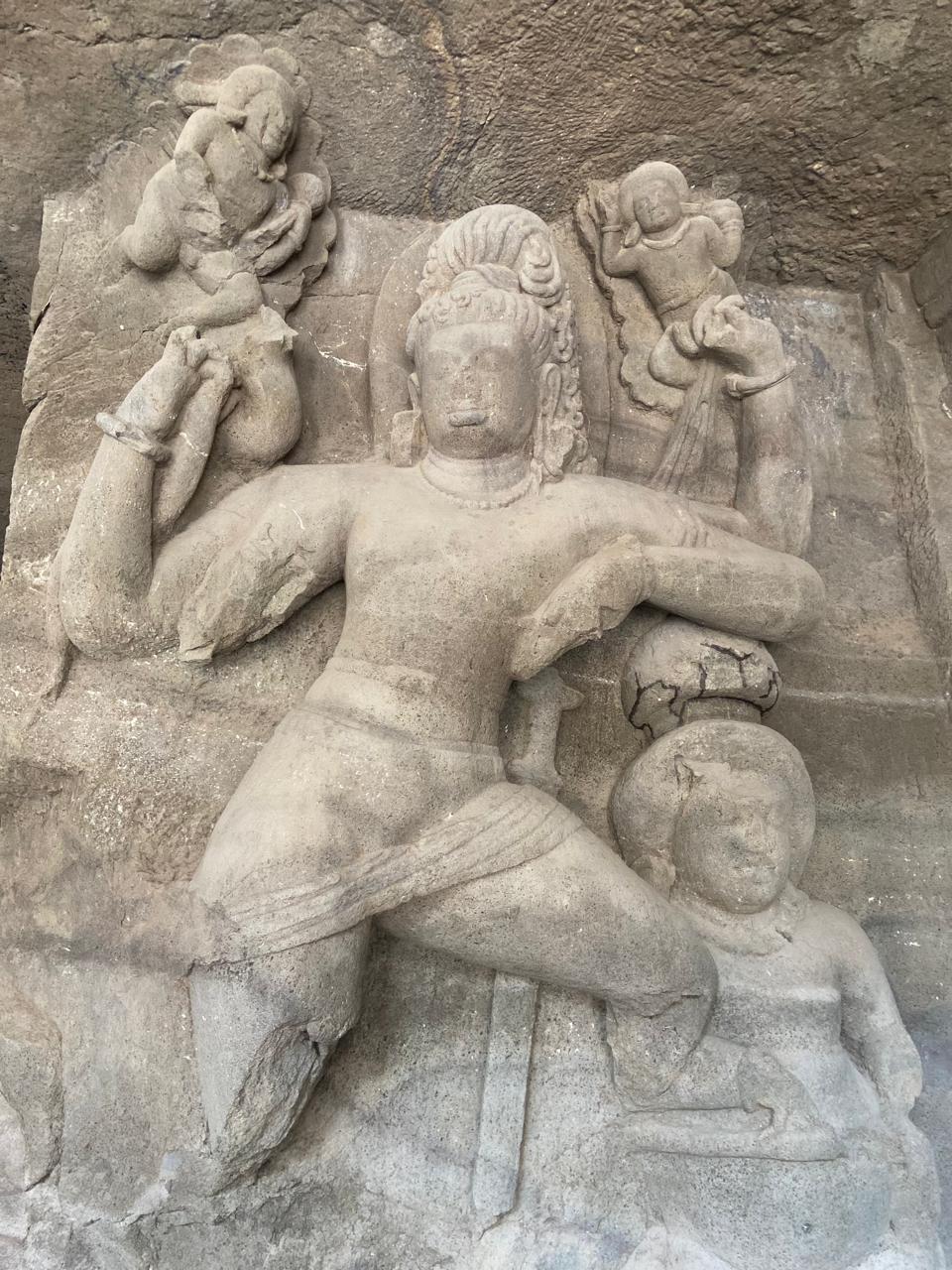
Around the main hall, the wall panels carry some of the finest narrative sculpture in western India. Here you will find Shiva as Nataraja in cosmic dance, the marriage of Shiva and Parvati, Ardhanarishvara combining male and female in one body, and the descent of the Ganga. Several panels also show visible damage from later centuries, which your guide will explain rather than gloss over.
Meanwhile, the smaller caves on the eastern hill stay quieter and often sit empty. Because the fast crossing buys you time, they are worth the extra walk.
The Archaeological Survey of India maintains the site, manages ticketing and conservation, and runs the small on-site museum. In addition, you can read more about Elephanta as a landmark of Deccan rock-cut architecture before you travel.
The island on foot
From the jetty, the path leads to a stairway of around 120 steps up to the cave entrance. It is a steady climb rather than a steep one, and stalls selling textiles, carvings and cold drinks line both sides.
Most guests manage the steps comfortably. However, if you would rather not climb, staff arrange a carried chair service at the base of the stairs for an additional charge.
A few practical notes for the walk:
- Footwear. Wear closed shoes with grip, because the stone has worn smooth in places.
- Water and sun. Carry water, since very little shade covers the path between the jetty and the cave entrance.
- Monkeys. They are present and confident, so keep food and loose items inside a bag.
- Time on the island. Allow two to two and a half hours from landing to boarding, and longer if you want the eastern caves.
Elephanta Caves private speedboat logistics: timings, tickets and seasons
Cave timings. The caves open Tuesday to Sunday, roughly 9:00 AM to 5:00 PM, and close on Mondays. Above all, avoid planning a Monday visit, because that remains the single most common mistake travellers make.
Tickets. An ASI entry ticket applies, with separate rates for Indian and foreign nationals. In addition, staff collect a small local island entry charge on arrival. The island train and the chair service also carry separate charges on site.
Best time of day. Depart between 8:30 and 9:30 AM. As a result, you reach the caves before the ferry crowd arrives, you climb in cooler air, and you see the main hall in the best light of the morning.
Season. October through March gives you the ideal window: dry, clear and comfortable. April and May turn hot, although an early departure still works well. During the monsoon, from roughly June to September, sea conditions frequently suspend small-craft operations. Crossings therefore run only in safe weather, and the licensed captain makes that call.
For cruise guests: fitting Elephanta into a port call
For cruise guests, the private speedboat stops being a preference and becomes the only workable option.
A typical Mumbai call gives you eight to ten hours ashore. On the public ferry, however, Elephanta consumes most of that: over two hours on the water alone, plus queuing, plus the climb. Furthermore, a full return boat can push you past your all-aboard time.
With a private crossing, by comparison, the entire Elephanta experience fits comfortably inside four hours from cruise terminal to cruise terminal. That leaves the rest of your day open for the city.
We build these crossings around ship schedules rather than fixed departure times. Specifically, we calculate return timing backwards from your all-aboard and we guarantee your return to the vessel. You can see the full range of Mumbai shore excursions we build on the same principle. Similarly, if you sail with Villa Vie Odyssey, our Mumbai port of call page covers the 30 and 31 December 2026 dates.
Private speedboat or the public ferry?
The honest answer depends on what you want to optimise for.
The ferry costs little, carries its own atmosphere, and works perfectly well if you have a full unhurried day, no fixed return time and cool weather. Plenty of people enjoy it.
On the other hand, the private speedboat wins whenever time is the constraint: a port call, a single day in Mumbai, travelling with children or older parents, or visiting between April and June, when two hours on an open ferry deck turns unpleasant.
We have written a full breakdown comparing Elephanta Caves by speedboat with the public ferry, covering cost, comfort, timing and reliability, so you can weigh it properly before you decide.
Alternatively, if you travel as a couple or a family and want the fast crossing without a full private charter, our small-group Elephanta Caves experience uses the same premium boats on shared departures.
How to plan and reserve
A well-run Elephanta Caves private speedboat day looks like this:
- First, a hotel or cruise terminal pickup in a private air-conditioned vehicle
- Next, you meet your guide at the Gateway of India jetty, and your guide handles the boarding formalities
- Then approximately 20 minutes across Mumbai Harbour
- After landing, the island train or a short walk to the base of the steps
- Guided exploration of Cave 1, the Trimurti and the surrounding panels, at your pace
- Free time for photographs, the eastern caves, or a cold drink
- Finally, the return crossing and drop-off
Our guides hold government licences, and several of them live on the island. That distinction matters more than it sounds, because they do not read their stories from a script.
We check sea conditions on the morning of departure. If the harbour looks unsafe, we say so and reschedule rather than sail.
To arrange a private crossing, contact our Mumbai team with your dates, your guest count, and, if you sail, your ship and port call timings. Meanwhile, our Elephanta Caves guide hub collects more background on the site and the experiences around it.
Frequently asked questions
How long does the private speedboat take to reach Elephanta Caves? Approximately 20 minutes each way from the Gateway of India. By comparison, the public ferry takes 60 to 75 minutes.
Are the Elephanta Caves open on Mondays? No. The caves close on Mondays, and they open Tuesday to Sunday, roughly 9:00 AM to 5:00 PM.
How many steps are there at Elephanta Caves? Around 120 steps from the base of the path to the cave entrance. However, if you prefer not to climb, staff can arrange a carried chair service on site for an additional charge.
Can I visit Elephanta Caves during a cruise port call in Mumbai? Yes. With a private speedboat crossing, the full experience fits inside roughly four hours from terminal to terminal, and we plan your return timing against your all-aboard.
Do speedboats run during the monsoon? Crossings operate only in safe sea and weather conditions. Between June and September, therefore, we frequently suspend departures and confirm on the morning of travel.
Is a guide included? Yes. A government-licensed guide accompanies every private crossing, and several of our guides live on the island itself.
Leave a Reply