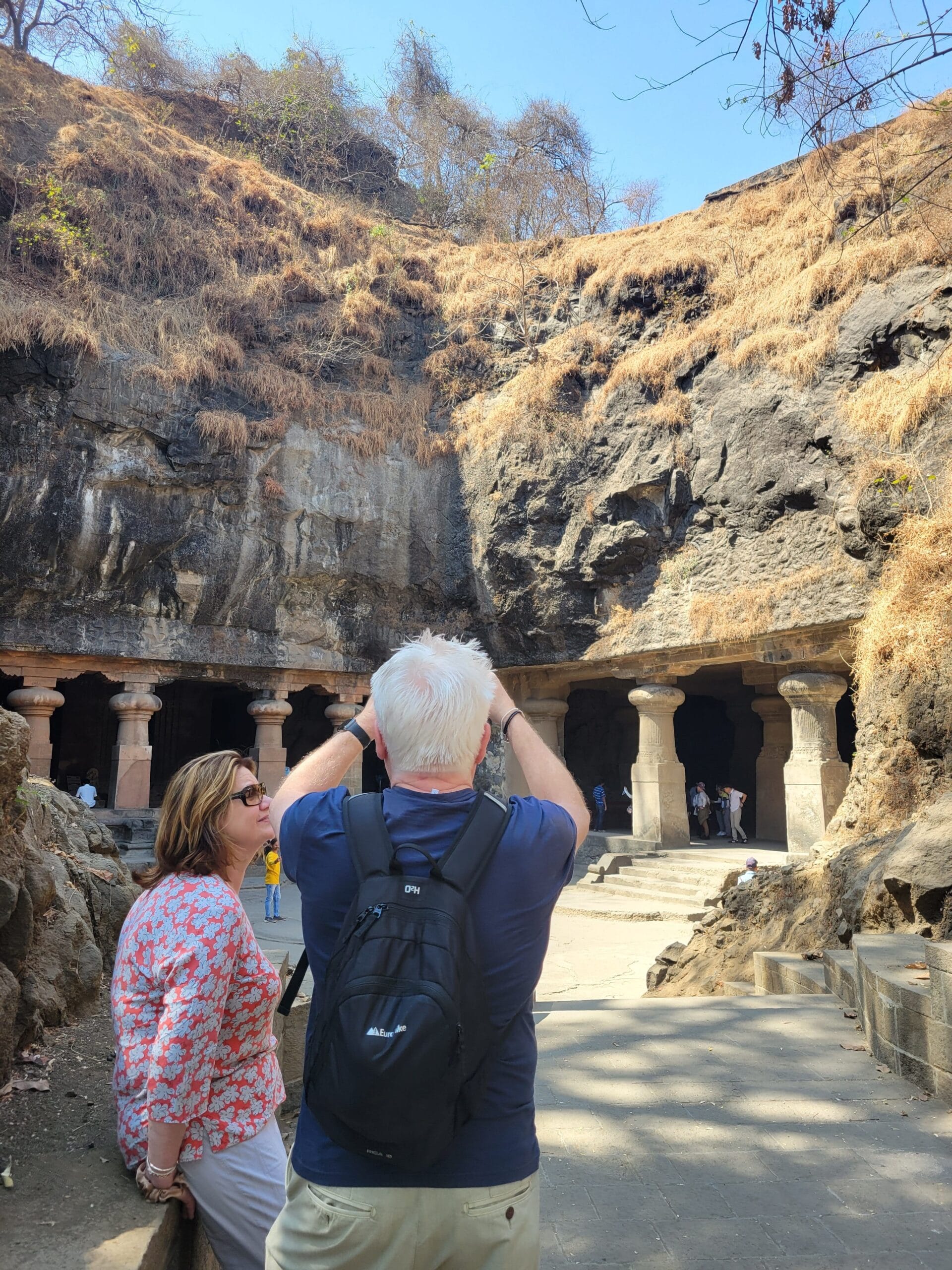
The Elephanta Caves Mumbai visitors have been crossing the harbour to see for centuries hold something that no photograph has ever fully captured. About four minutes into Cave 1, the light catches the central face of the Trimurti and something happens not because a guidebook told you it would, but because the carving is twenty feet high, fourteen hundred years old, and it has the unsettling quality of something that is still, quietly, thinking.
Most visitors photograph that and leave. They have not seen Elephanta. Not even close. There are seven caves on this island, a UNESCO World Heritage Site since 1987, and the majority of tourists enter one. There are panels that took master sculptors years to complete, a hilltop view of Mumbai Harbour that almost nobody climbs to, and a silence inside Cave 3 in the late afternoon that you will remember for a long time. This is the guide for visitors who came to actually see it.
01 of 10
The Trimurti – Not the Way You Think You Know It
Every visitor sees the Trimurti. Almost none understand it. The three faces are not three gods standing together. They are three aspects of one divine reality the eternal, the creator, the destroyer encoded in a single sculpture. The artists who carved this understood something it took Western philosophy centuries to reach: creation and destruction are the same process, seen from different points in time. Stand there long enough to feel that, and the carving changes entirely.
Quick FactThe Trimurti stands approximately 6 metres tall and is considered one of the finest examples of Indian rock-cut sculpture in existence. It is the focal masterpiece of Cave 1, also known as the Great Cave or Shiva Cave.
02 of 10
Five Other Caves That Are Almost Always Empty
The Elephanta Caves Mumbai complex has seven caves in total. Cave 1 takes all the foot traffic. Caves 3, 4, and 5 are smaller Hindu shrines more intimate, less damaged, and on a quiet afternoon, entirely yours. Caves 6 and 7 on the eastern hill are Buddhist in origin, predating the famous Hindu caves by several centuries, dating to around the 2nd century BC. Walk past Cave 1 and keep going. The crowds thin immediately.
“The sculptors were not decorating a temple. They were building a library and most visitors only read the cover.”
03 of 10
Ardhanarishvara – The God Who Is Half Woman
On the south wall of Cave 1 is a panel that stops serious scholars cold. Ardhanarishvara — the Lord Who Is Half Woman — shows Shiva fused with Parvati, the right half male, the left half female, in a single body. The ornaments differ on each side. The hair differs. The posture of each half is distinct. This is not mythology for mythology’s sake. It is a precise theological argument about the inseparability of masculine and feminine energy in the universe, rendered in basalt with absolute command.
Quick Quiz
The Ardhanarishvara panel depicts which two divine figures fused into one form?Brahma and SaraswatiShiva and ParvatiVishnu and Lakshmi
04 of 10
Kalyanasundara – The Divine Wedding Nobody Attends
On the northern wall, away from the Trimurti and often underlit, is the wedding of Shiva and Parvati. Brahma officiates. Vishnu stands as a witness. What makes the panel remarkable is not its iconography – it is Parvati’s posture. The sculptor gave her a specific turn of the head, a slight inclination of the body, that has no theological function. It exists purely to show feeling. Someone, fourteen centuries ago, chose to carve not just the ceremony but the emotion inside it. That is the work of an artist, not merely a craftsman.
05 of 10
How the Light Rewrites the Caves Entirely
The architects of Cave 1 were also lighting designers. The entrance orientation, column spacing, and depth of the inner sanctum were all calculated against the movement of sunlight. The Trimurti sits in shadow at 10 AM. By midday the central hall floods with light. At 4 PM, light falls at a low angle across the panels, deepening the relief, creating shadows that did not exist at noon. Visit Elephanta in the morning and you see one cave. Return in the late afternoon and you are in a different place entirely.
06 of 10
The Gangadhara Panel – A River Caught in His Hair
The east wall of Cave 1 carries one of the most narratively ambitious sculptures on the island. In the myth, King Bhagiratha performed extreme penance to bring the Ganges from heaven to earth. But the force of a celestial river would have destroyed the world. Shiva intervened — catching the river in his matted hair and releasing it gently in streams. The sculptor captured not just the myth but the physics of it: Shiva towering, the goddess Ganga visible in his locks, celestial figures watching from above, earthly figures looking upward at a river descending from the top of the frame. It is as close to cinematic storytelling as stone can get.
Historical NoteElephanta Island was known in ancient times as Gharapuri – “city of caves.” The Portuguese renamed it “Elephanta” in the 16th century, after a stone elephant they found near the landing point. That elephant now stands at the Jijamata Udyan in Mumbai, moved there for preservation in the 19th century.
07 of 10
The Buddhist Ruins – A World That Came Before
The Hindu caves are spectacular, but they were not the island’s first act. UNESCO documentation and archaeological evidence both point to Buddhist occupation as early as the 2nd century BC – nearly a thousand years before the major Shaiva shrines were carved. Elephanta Island was considered sacred across two great religious traditions, across more than a millennium. The island was not chosen for its caves. The caves were made because something about this place already felt significant. That continuity of reverence is part of what you walk into when you arrive.
08 of 10
The Hilltop Cannon and the View Nobody Climbs To
There is a path from the main cave area that climbs to the top of the island. Most visitors do not take it. At the top: a Portuguese-era cannon from the 16th century, and one of the finest views of Mumbai Harbour available from outside the city – the entire sweep of the water, South Mumbai’s skyline, the distant horizon of the Arabian Sea. The air is cooler, the crowd is gone, and a rusted cannon points at a skyline that did not exist when it was placed there. The juxtaposition alone is worth the walk.
09 of 10
Ancient Water Cisterns – Engineering Nobody Photographs
Carved into the bedrock away from the main caves are large water tanks, cut directly into the rock, that once served the community living and working on the island. They are easy to miss and unmarked on most visitor maps. But they are among the most human things here – proof that behind the theological ambition of the sculptures, there were ordinary people with ordinary needs. The same culture that produced the Trimurti also needed to manage its water supply. That detail makes the whole island feel different.
10 of 10
The Sound – What the Elephanta Caves Mumbai Were Built to Do
The final discovery cannot be photographed. When the crowds thin and the afternoon light is low, Cave 1 produces a resonance – the columns, the chamber depth, the stone – that you feel in your chest more than you hear with your ears. The same phenomenon exists in medieval cathedrals. The dimensions of this cave were not accidental. The height, the column spacing, the depth of the inner sanctum – they create an acoustic specific to this place and no other. It is the oldest thing on the island and the hardest to explain. Stand still long enough and it finds you.
Everything above is available to any visitor who arrives with curiosity and enough time. That last part – time – is the one thing most people underestimate.
The public ferry from the Gateway of India takes 90 minutes each way. By the time most visitors arrive at the caves, a significant portion of the morning is already gone. If you are visiting Mumbai on a cruise stopover – where shore time is finite and fixed – that equation becomes even more unforgiving.
Explore our Elephanta experiences:
https://shoreexcursiontoursindia.com/